1
Weldon Earl Borland
1906–2002
Son of James Couthren and Lizzie Alberta (Miller) Borland
Weldon Borland descendants2
Borland/Miller descendants not already counted — N/A (Weldon’s siblings all died childless)0
Unresolved Borland vs. Miller63
← Family history research index
Tracing a large Ancestry DNA match cluster through sub-clustering, colonial Maryland Wheelers, and a mapped segment on chromosome 9.
The following chart summarizes the current state of my analysis of my great-uncle Jeffrey James Borland’s Ancestry DNA matches. The chart tabulates only those matches who share more than 20 centimorgans (cM) of DNA with him. I first used Ancestry’s SideView technology to distinguish Jeff’s paternal DNA matches from his maternal matches. Then, using a modified version of the Leeds clustering method and Ancestry’s colored match groups, I organized his paternal matches into clusters and attempted to assign them to the ancestral branches of his father, Weldon Earl Borland (1906–2002).
The chart traces Weldon’s ancestry back through his eight great-grandparents, showing how many DNA matches have been assigned to each branch. Some matches can be associated with descendants of specific ancestral couples, while others can be traced to only one side of a couple or remain unresolved between the two. The chart also identifies matches whose precise ancestral connections have not yet been established.
Son of James Couthren and Lizzie Alberta (Miller) Borland
Son of James and Catherine (Walker) Borland
Son of James and Mary (McQuiston) Borland
Son of Samuel and Lydia (Gregg) Borland
Daughter of John and Barbara Simpson (Arthur) McQuiston
Daughter of Oliver Hazard Perry and Tabitha (Burgess) Walker
Son of Ninian Y and Catherine (Russell) Walker
Daughter of Samuel and Ruth (Sansom) Burgess
Daughter of Samuel Hoobler and Mary Jane (Smith) Miller
Son of Harrison and Mary Ann (Wheeler) Miller
Son of Andrew Miller and Margaret Kail (unwed)
Daughter of Mordecai and Keziah Murray (Gill) Wheeler (2nd cousins)
Daughter of John Peregoy and Hannah (Welch) Smith
Son of Daniel and Elizabeth (Peregoy) Smith
Daughter of William and Margaret (Barrett) Welch
Although considerable progress has been made, three types of gaps remain in the analysis. The first involves ancestral lines for which few or no DNA matches have been identified beyond the earliest known ancestors. For example, no matches have been assigned to either the Ninian Y Walker or Catherine Russell lines beyond their son, Oliver Hazard Perry Walker. The second involves ancestral couples for whom additional collateral descendant lines may exist but have not yet been identified among the DNA matches, such as William Welch and Margaret Barrett, for whom no matches have been assigned to descendants of the couple outside Hannah Welch’s line. The third involves groups of matches that can be associated with a particular ancestral couple but cannot yet be assigned to either the paternal or maternal side of that couple. For example, 26 matches associated with John McQuiston and Barbara Simpson Arthur remain unresolved between the McQuiston and Arthur ancestral lines.
The most conspicuous unresolved group appears at the very top of the chart. Of Jeff’s matches, 63 have not yet been assigned to either Weldon’s paternal Borland ancestry or his maternal Miller ancestry. Fifty of these matches belong to a single cluster, which I have provisionally named the Gaut cluster. The name comes from a preliminary examination of several matches’ Ancestry family trees, which revealed that a number of them descend from a couple named John and Letitia Gaut. The Gauts lived in the Dandridge area of Jefferson County, Tennessee, where they apparently spent much of their adult lives and raised their children. Whether John and Letitia themselves, or someone in their extended families, can be connected to Weldon’s ancestry remains unknown.
There is also a promising genetic clue. By identifying two of Jeff’s Ancestry matches on MyHeritage, where chromosome segment information is available, I was able to locate DNA associated with the Gaut cluster near the western end of chromosome 9. The precise segment boundaries, nearby mapped ancestral segments, and Ancestry’s ethnicity assignments for this region will be examined later in the article.
For now, the question is whether investigating this unusually large cluster of matches might help fill one of the remaining gaps in Weldon Borland’s family history. Who was John Gaut, and what, if anything, connects his family to ours?
Having identified the Gaut cluster among the matches that could not yet be sorted onto Weldon’s Borland or Miller lines, I turned next to the question of internal structure. The fifty matches that make up the cluster on paper are not necessarily all close cousins to one another; some may descend from different branches of the same extended family, and others may connect only through the segment they share with Jeff. To see whether the cluster broke into smaller, genealogically meaningful groups, I applied the sub-clustering procedure described below.
The analysis rested on two distinct thresholds, and it is important not to confuse them. The first governed which of Jeff’s matches I treated as primary subjects for this stage. I selected every member of the Gaut cluster who shares at least 25 cM of DNA with Jeffrey James Borland. That cutoff defines who entered the study as an anchor kit tied directly to Jeff’s test. The second threshold governed how those kits—and certain additional ones—were grouped with one another. I set the sub-clustering threshold at 45 cM: two matches belong to the same sub-cluster when at least one pair in their shared-match network shares at least 45 cM with the other. That figure describes relationships among matches in the cluster, not the amount any of them shares with Jeff.
The 45 cM rule also allowed me to pull in matches who share less than 25 cM with Jeff when their shared-match relationships still met the clustering criteria. In practice, a lower-cM match could appear in a sub-cluster if they were linked into it through sufficiently strong connections to other kits already in the network. This is the same logic that lets secondary shared matches illuminate structure in a Leeds-style analysis: Jeff’s own match strength sets the door, but cousin-to-cousin sharing defines the rooms inside.
One of the nine sub-clusters stood out immediately because of its size and because of the considerable internal structure visible even before any new tree work. Its lead match, Tara, shares 33 cM with Jeff—the highest shared cM of any kit in the group. The sub-cluster as a whole contains 54 of Jeff’s DNA matches, more than the rest of the sub-clusters combined, and large enough to suggest multiple descendant lines fanning out beneath a common ancestor or ancestral couple.
That scale alone would justify a closer look, but there is an additional reason to begin here. Several matches in this sub-cluster already have family trees on Ancestry that I had identified in the preliminary pass as tracing back to John and Letitia Gaut of Jefferson County, Tennessee—the same couple who gave the wider Gaut cluster its name. Documented Gaut descendants inside the largest sub-cluster make it the logical starting point for a closer genealogical investigation: they offer concrete surnames, places, and parent–child links to compare against Weldon’s pedigree.
That lead is not the same as an answer. The presence of Gaut descendants among Jeff’s matches shows where some of his DNA cousins come from on paper; it does not by itself establish how John Gaut’s family connects to Jeff’s ancestry, or whether the connection runs through Borland, Miller, or another line entirely. The work that follows takes up the largest sub-cluster on its own terms—first to understand who its members are, and only then to ask what, if anything, their trees imply for Weldon Borland’s missing branch.
The largest sub-cluster contained 54 DNA matches. Examination of the participants’ family trees revealed several distinct genealogical groups, some with well-documented relationships to one another and others whose connections remain uncertain.
The first group consisted of 24 descendants of two brothers, Benjamin Gaut (born 1790) and Joseph Gaut (born 1798), sons of John and Letitia Gaut. Ten participants descended from Benjamin, while fourteen descended from Joseph. These matches provided the strongest documentary basis for associating this sub-cluster with the Gaut family.
A second group consisted of eight descendants of the Jones family. Seven traced their ancestry to Paradine Jones, born in Missouri in 1871 to John Francis Marion Jones and Catherine Dorcas (Sloan) Jones. One additional participant descended from Paradine’s younger sister, Ida Adeline Jones, born in 1872. Another participant, identified as Andrew, lacked sufficient genealogical information to reconstruct his ancestry and had no immediately identifiable family connections within the sub-cluster. However, Andrew shared 99 cM with one of Paradine Jones’s descendants, suggesting a potentially useful connection to that family.
A third group consisted of thirteen matches associated with the Jenkins family of Virginia. Seven descended from Hedgeman Jenkins, born in 1793 in what is now Rappahannock County, Virginia, to Anthony George and Mary (Chilton) Jenkins. Five descended from Hedgeman’s older brother, Anthony Jenkins, born in 1790. An additional participant bearing the Jenkins surname shared 72 cM with one of Hedgeman’s descendants, although the precise genealogical relationship has not yet been established.
Another four matches descended from Cleo Reed, born in Missouri in 1915 to Andrew Jackson and Cora Marie (Durbin) Reed. Although the parents of Andrew Jackson Reed remain unidentified, the Reed descendants share substantial amounts of DNA with descendants of Hedgeman Jenkins, including one match of 131 cM. This provides strong evidence of a connection between the Reed and Jenkins families and suggests that Andrew Jackson Reed may have descended from Hedgeman or one of his close relatives. The precise relationship remains to be determined.
Finally, four additional participants clustered closely with descendants of Anthony Jenkins (born 1790), sharing as much as 77 cM with members of that line. Their available family trees were insufficient to establish a documentary connection, but their genetic relationships suggest that they may descend from Anthony Jenkins or another member of his immediate family, potentially including an additional sibling.
Taken together, these findings reveal that the largest sub-cluster contains several identifiable genealogical groups: descendants of the Gaut brothers, descendants of the Jones sisters, descendants of the Jenkins brothers, and a probable Jenkins-associated Reed family. The remaining participants have varying degrees of genetic association with these groups but cannot yet be placed confidently within their pedigrees.
The central question is whether these families are connected through a common ancestral relationship, multiple independent relationships, or a combination of the two. Establishing those connections may help explain why their descendants appear together among Jeff’s DNA matches and, ultimately, how this sub-cluster relates to Weldon Borland’s ancestry.
An important clue emerged from the Jones family. According to genealogical trees on Ancestry, John Francis Marion Jones was a third great-grandson of Solomon Wheeler, born in 1725 in St. Paul’s Parish, Baltimore County, Maryland. Solomon belonged to a Wheeler family already represented in Weldon Borland’s known ancestry. Weldon’s ancestor Mary Ann Wheeler (1822–1858) is believed to descend from this extended family through five separate ancestral lines, including two through Solomon’s half-brother William Wheeler (born 1694) and two through his full sister Mary (Wheeler) Murray (born 1711). This unusually complex pedigree reflects multiple generations of intermarriage. Mary Ann Wheeler’s parents, Mordecai Wheeler and Keziah Murray Gill, were themselves related, both descending from Benjamin Wheeler and Keziah Murray, who were also Wheeler cousins.
This connection offers a promising explanation for the presence of the Jones descendants within the Gaut sub-cluster, but it remains a hypothesis rather than an established genealogical link. Accepting it would require relying heavily on Ancestry family trees to bridge several generations of ancestry that have not yet been independently verified. A broader working theory is that the Gaut and Jenkins families may also connect to descendants of Solomon Wheeler or his extended family, whose members migrated southward from the Baltimore region through the Appalachian Valley. Both families include women whose maiden names remain unknown, leaving open the possibility of Wheeler connections that have escaped documentation. The genetic clustering is consistent with such a theory, but does not establish it. Testing these proposed relationships will require additional documentary research, particularly into the unidentified wives and maternal lines of the Gaut and Jenkins families.
Another of Weldon’s maternal ancestors, Mary Jane Smith (1850–1946), also descended from the Wheeler family through William Wheeler (born 1694), the previously mentioned half-brother of Solomon Wheeler. Thus, the Wheeler family appears in both the Mary Ann Wheeler and Mary Jane Smith branches of Weldon’s maternal ancestry. However, if the Gaut sub-cluster’s connection to Weldon ultimately traces through Solomon Wheeler’s family, Mary Ann Wheeler’s ancestry appears the more promising avenue of investigation. She is believed to descend twice from Solomon’s full sister, Mary (Wheeler) Murray, and twice more through his half-siblings, whereas Mary Jane Smith has only one known line of descent through Solomon’s half-brother William. Although this does not establish which branch accounts for the DNA matches, it provides a reasonable basis for prioritizing Mary Ann Wheeler’s ancestry in the investigation.
The sub-clustering pass described earlier left three matches as singletons: kits that tied into the Gaut cluster through shared-match relationships but did not meet the 45 cM threshold for placement in any of the nine sub-clusters. Two of them are worth noting here because they share relatively large amounts of DNA with Jeff yet offer almost nothing on paper. Kathryn matches Jeff at 32 cM; M. B. matches at 30 cM. Both figures place them among the stronger Gaut-cluster matches on Jeff’s list—comparable in scale to Tara’s 33 cM lead in the largest sub-cluster—but neither participant supplied sufficient information in Ancestry’s match profile or in any linked tree from which I could build out a pedigree.
The next sub-cluster consisted of three DNA matches, the strongest of whom, Jen, shared 29 cM with Jeff. All three participants descended from two sisters, Edna Dale (born 1898) and Maria Dale (born 1904), daughters of Ernest Latta Dale and Arabelle (Tolbert) Dale of Philadelphia, Pennsylvania.
Unlike the largest sub-cluster, this group revealed no obvious genealogical connection to the Wheeler family or to any of the other ancestral lines examined thus far. Although the shared ancestry of the three participants establishes a clear genealogical basis for their grouping, its connection to Jeff remains unresolved. Further documentary research into the ancestral lines of Ernest Latta Dale and Arabelle Tolbert will be necessary to determine whether this family connects to the Wheeler lineage or another branch of Weldon Borland’s ancestry.
The Houston sub-cluster contained 16 DNA matches, the strongest of whom shared 29 cM with Jeff. Eleven participants descended from Mary Melissa Houston (born 1809), while another descended from her double first cousin, Thomas Houston (born 1814). Both individuals belonged to the Houston and Kirk families, providing a common genealogical foundation for twelve of the sixteen matches.
The Houston ancestry can be traced back to Ireland and Scotland within a few generations, without any apparent connection to the Baltimore region. Consequently, if this sub-cluster is connected to the Wheeler family discussed earlier, the Kirk ancestry appears to be the more promising avenue of investigation. Such a connection remains hypothetical, however, and would require additional documentary evidence.
The remaining four participants had less clearly established genealogical connections to the Houston descendants, sharing between 45 and 52 cM with one or more members of that group. One of these participants had a family tree containing Jenkins and Jones ancestors from Alabama, raising the possibility of a connection to the Jenkins and Jones families identified in the largest sub-cluster. However, no such relationship could be established from the available information. Given the frequency of both surnames, their appearance in this tree may be coincidental rather than evidence of a shared ancestral connection.
For now, the Houston sub-cluster represents another distinct genealogical grouping within the broader Gaut cluster. Further research into the Kirk family and the unidentified ancestral connections of the remaining participants may help determine whether this group shares an underlying relationship with the Wheeler, Gaut, Jenkins, or Jones families already examined.
Two additional sub-clusters traced to the same family from Lancaster County, Pennsylvania. The first consisted of six descendants of Julia Ann Barnett (born 1809), with a lead match sharing 29 cM with Jeff. The second contained four descendants of Julia’s younger sister, Mary Barnett (born 1815), with a lead match of 27 cM. Both sisters were daughters of John Kilgore Barnett and his wife Nancy, whose maiden name remains unknown.
Although the descendants of Julia and Mary formed separate sub-clusters under the 45 cM threshold, their documented ancestry establishes a connection between the two groups through the Barnett family. Together, they account for ten of Jeff’s matches and provide another identifiable family line within the broader Gaut cluster.
The remaining singleton, Diane, shared 26 cM with Jeff and descended from a Barnett family in Kentucky. This raises the possibility that she belongs to the same extended family as the Lancaster County Barnetts, although no documentary connection has yet been established. Given the frequency of the Barnett surname, the similarity alone is insufficient to demonstrate a relationship.
No obvious genealogical connection has emerged between these Barnett families and the Wheeler lineage or any of the other families examined in the preceding sub-clusters. Further research into the ancestry of John Kilgore Barnett and his wife Nancy, particularly Nancy’s unidentified family, may help clarify how these matches fit into Weldon Borland’s ancestry. The Kentucky Barnett family likewise warrants investigation to determine whether its apparent association with the Pennsylvania families reflects a genuine ancestral connection or merely a coincidental surname.
The Nicholson sub-cluster consisted of three DNA matches, the strongest sharing 29 cM with Jeff. All three participants descended from Sarah Nicholson, born in 1925 in Fayette County, Pennsylvania. Examination of her family tree revealed numerous ancestors from colonial Maryland, a geographic connection of potential interest given the Wheeler family’s origins in the Baltimore region. However, no Wheeler ancestors were identified in her documented pedigree, nor did any obvious connections emerge to the other families examined in the preceding sub-clusters.
Although the Maryland ancestry makes this group worthy of further investigation, geographic proximity alone is insufficient to establish a genealogical relationship. Additional documentary research into Sarah Nicholson’s ancestral lines will be necessary to determine whether a connection exists to the Wheeler family or another branch of Weldon Borland’s ancestry.
The next sub-cluster provided the first direct genealogical connection to the Wheeler family already represented in Weldon Borland’s ancestry. It consisted of two matches, sharing 26 cM and 16 cM with Jeff, respectively, who shared 49 cM with one another. Both participants had documented lines of descent from members of the extended Wheeler family of colonial Maryland.
The stronger match, at 26 cM, descended from Thomas Wheeler (born circa 1660), brother of Weldon’s ancestor William Wheeler (born circa 1670). Thomas was therefore an uncle of the previously discussed William Wheeler (born 1694), Mary (Wheeler) Murray (born 1711), and Solomon Wheeler (born 1725). The brothers Thomas and William are reported to have been born in Charles County, Maryland, before William’s branch of the family became established in the Baltimore area. This match is particularly significant because it connects the sub-cluster to an ancestral generation preceding the Wheeler siblings considered in the analysis of the largest Gaut sub-cluster.
The second match, sharing 16 cM with Jeff, provides additional support for a Wheeler origin of the DNA represented in this sub-cluster. This participant descended from Nicholas Wheeler (born 1772 in Baltimore), the youngest son of Benjamin Wheeler (1727–1807) and Keziah Murray (1729–1806). Benjamin and Keziah, themselves Wheeler cousins, were ancestors of Mary Ann Wheeler (1822–1858) through both her father and her mother.
Nicholas was a younger brother of William Wheeler (born circa 1755), the probable father of Mary Ann’s paternal grandfather, Mordecai Wheeler (born 1787). Nicholas was also a younger brother of Rachel (Wheeler) Murray (born 1752), the maternal grandmother of Mary Ann’s mother, Keziah Murray (Gill) Wheeler. Consequently, Nicholas belonged to the same closely interrelated family that appears on both sides of Mary Ann’s pedigree.
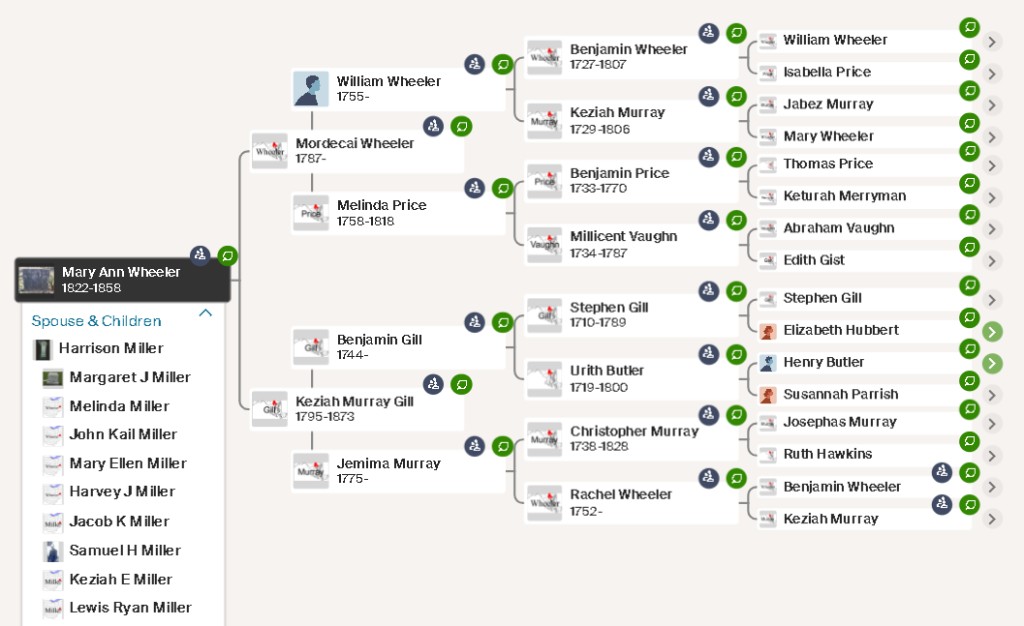
The proposed relationship between Mordecai Wheeler and William Wheeler (born circa 1755) deserves a qualification. No birth record identifying Mordecai’s parents has been located, and the evidence connecting him specifically to William is circumstantial. Nevertheless, the available evidence places Mordecai within this family, most likely as a son of William or one of William’s brothers. This uncertainty does not materially affect the present analysis, since either relationship would connect Mordecai to the same Wheeler ancestral family.
The geographic history of this family provides further context. Nicholas Wheeler settled in the same part of Harrison County, Ohio, as Mary Ann Wheeler’s parents. More broadly, descendants of Benjamin Wheeler and Keziah Murray were among the pioneers of Jefferson and Harrison Counties, Ohio, carrying branches of this Maryland family westward into the region where Weldon’s maternal ancestors later lived.
Unlike the preceding sub-clusters, whose possible connections to the Wheeler family depended on unverified genealogical hypotheses, this group contains two independently identified lines of Wheeler descent. Their mutual match of 49 cM, together with their respective matches to Jeff, strengthens the case that Wheeler ancestry contributes to the broader Gaut cluster. It does not, by itself, establish that every sub-cluster shares the same Wheeler origin or identify the precise ancestral pathway responsible for the shared DNA. Nevertheless, it provides an important point of reference for evaluating the proposed Wheeler connections elsewhere in the analysis.
The final two sub-clusters each had a lead match sharing 25 cM with Jeff. The first consisted of three participants, none of whom had family trees containing sufficient information to investigate their ancestry. Consequently, no genealogical connections could be established among these matches or between them and the families identified in the other sub-clusters.
The second consisted of seven matches, all descendants of two brothers, Earl Billingsley (born 1894) and John Billingsley (born 1897). Their common ancestry establishes a clear genealogical relationship among the participants, but no obvious connection has emerged between the Billingsley family and the Wheeler lineage or any of the other families examined in this analysis.
Both sub-clusters therefore remain unresolved with respect to their connection to Weldon Borland’s ancestry.
| Sub-cluster | Matches | Lead cM with Jeff | Genealogical anchor | Wheeler connection |
|---|---|---|---|---|
| Largest (Gaut) | 54 | 33 | Descendants of Benjamin and Joseph Gaut; also Jones, Jenkins, Reed, and related lines | Hypothesis via Paradine Jones → Solomon Wheeler |
| Dale | 3 | 29 | Sisters Edna and Maria Dale, Philadelphia | None identified |
| Houston | 16 | 29 | Mary Melissa Houston and cousin Thomas Houston; Kirk family | Hypothesis via Kirk line |
| Barnett (Julia) | 6 | 29 | Julia Ann Barnett, Lancaster County, Pennsylvania | None identified |
| Barnett (Mary) | 4 | 27 | Mary Barnett, Lancaster County, Pennsylvania | None identified |
| Nicholson | 3 | 29 | Sarah Nicholson, Fayette County, Pennsylvania | Colonial Maryland ancestry; no Wheeler in documented tree |
| Wheeler | 2 | 26 | Thomas Wheeler (c. 1660) and Nicholas Wheeler (1772) | Direct documented Wheeler descent |
| Unlinked trees | 3 | 25 | Insufficient tree information | — |
| Billingsley | 7 | 25 | Brothers Earl and John Billingsley | None identified |
The Gaut cluster originally comprised 50 of Jeff’s matches at ≥20 cM; sub-cluster counts can exceed that figure because kits below 25 cM with Jeff enter through the 45 cM cousin-to-cousin network. Three additional singletons (Kathryn, 32 cM; M. B., 30 cM; and Diane, 26 cM, Kentucky Barnett) did not join any sub-cluster.
An important additional finding emerged from examining the physical location of the DNA associated with the Gaut cluster. Although Ancestry does not provide chromosome segment coordinates for its matches, I was able to locate descendants of both Benjamin Gaut and Joseph Gaut in the MyHeritage database and use its chromosome browser to identify the segments they shared with Jeff. I then incorporated these results into my Borland Genetics chromosome reconstructions.
The descendant of Benjamin Gaut matched Jeff on chromosome 9 from position 1,528,388 to 13,609,121, a segment measuring 20.2 cM. The descendant of Joseph Gaut matched him from position 1,757,494 to 10,668,199, measuring 15.6 cM. Both sets of coordinates use genome build 37. These segments overlap substantially and identify the westernmost portion of Jeff’s paternal chromosome 9 that I have been able to map. The lead match in the largest Gaut sub-cluster shares 33 cM with Jeff, indicating that the full extent of the DNA associated with this group may be greater than either of the segments identified through MyHeritage.
The placement of this region becomes particularly revealing when compared with the ancestral segments immediately to its east. The Gaut-associated segment, which I attribute to the ancestry of Mary Ann Wheeler (1822–1858), is followed by a segment extending from position 13,610,779 to 20,883,241, measuring 9 cM. This second segment has been assigned to Hannah Welch (1824–1901), based on a cluster of matches descending from her mother Margaret Barrett’s family of Harford County, Maryland.
The boundary between these two segments represents a significant transition in Weldon’s maternal ancestry. Lizzie Alberta Miller inherited chromosome 9 from both of her parents, Samuel Hoobler Miller and Mary Jane Smith. The western portion, associated with the Gaut cluster and attributed to Mary Ann Wheeler, came through Samuel Hoobler Miller, whose mother was Mary Ann Wheeler. Immediately to its east, the chromosome switches to DNA inherited through Lizzie’s mother, Mary Jane Smith, specifically through Mary Jane’s mother, Hannah Welch. This pattern is consistent with a crossover during the meiosis in which Lizzie transmitted chromosome 9 to her son Weldon. The mapped transition falls near position 13.61 million, although the precise crossover point cannot be determined from the available segment boundaries.
A second transition appears immediately east of the Hannah Welch segment. From position 20,890,467 to 79,189,091, a span measuring 58.2 cM, the chromosome has been assigned to John Peregoy Smith (1822–1903), the husband of Hannah Welch and father of Mary Jane Smith. This assignment is corroborated by a match between Jeff and a descendant of John’s paternal aunt, Mariah (Smith) Plummer. Ancestry’s chromosome painter also assigns Swiss ethnicity to this region, consistent with the known Swiss Schmidt ancestry of John’s father, Daniel Smith.
The transition near position 20.89 million reflects a recombination one generation earlier than the preceding boundary. Mary Jane Smith inherited one chromosome 9 from her mother, Hannah Welch, and another from her father, John Peregoy Smith. When she transmitted chromosome 9 to her daughter Lizzie Alberta Miller, the resulting chromosome contained DNA from both parental lines: a segment originating with Hannah Welch’s mother, Margaret Barrett, followed by a segment originating with John Peregoy Smith’s father, Daniel Smith. Thus, the transition from the Barrett-associated segment to the Schmidt-associated segment can be attributed to a crossover during Mary Jane Smith’s transmission of chromosome 9 to Lizzie.
The arrangement is particularly striking because two recombination events, occurring in successive generations, are represented by adjacent ancestral boundaries separated by only about 7.3 million base pairs. The western end of chromosome 9 is a region of relatively frequent recombination, so the proximity of these transitions is not unexpected. Nevertheless, their placement provides a coherent explanation for how DNA from three distinct ancestral lines came to occupy neighboring portions of the chromosome inherited by Jeff.
Farther east, beyond the segment assigned to John Peregoy Smith, the chromosome remains unresolved genealogically. Ancestry’s chromosome painter assigns Ulster Ireland ethnicity to this region, suggesting a possible transition from Weldon’s maternal Miller ancestry to his paternal Borland ancestry. Several branches of James Couthren Borland’s family, including the Borland and McQuiston lines, originated in Ulster. If this interpretation is correct, the transition would reflect a crossover during Weldon’s transmission of chromosome 9 to his son Jeff.
The mapped sequence therefore provides an unusually clear illustration of successive generations of recombination. Moving from west to east along Jeff’s paternal chromosome 9, the DNA passes from a segment attributed to Mary Ann Wheeler’s ancestry, through a segment associated with Margaret Barrett, and then into a long segment associated with Daniel Smith’s Swiss ancestry. The first transition is consistent with recombination during Lizzie Alberta Miller’s transmission to Weldon, while the second reflects an earlier recombination during Mary Jane Smith’s transmission to Lizzie. An additional transition farther east almost certainly represents recombination between Weldon’s maternal and paternal chromosomes.
Most importantly, the placement of the Gaut-associated DNA supports its attribution to the Mary Ann Wheeler branch of Weldon’s maternal ancestry. This is consistent with the documentary and genetic evidence identifying Wheeler descendants elsewhere in the Gaut cluster, and it provides a more specific direction for investigating the proposed relationships among the Gaut, Jenkins, Jones, and Wheeler families.
After examining the genealogical relationships within the Gaut cluster and locating its associated DNA on chromosome 9, we can finally offer a tentative answer to the question posed in this article. Either John Gaut, or his wife Letitia, was almost certainly descended from the extended Wheeler family of colonial Maryland. The precise connection remains unidentified, but the combination of genetic clustering, documented Wheeler descendants, and chromosome segment mapping provides compelling evidence that the Gaut family belongs somewhere within this broader ancestral network.
The relationships among the other families in the largest sub-cluster offer intriguing possibilities. Could John Gaut’s mother have been a Jenkins? Could Letitia’s maiden name have been Jenkins, connecting her to the family of Hedgeman and Anthony Jenkins? These are speculative suggestions, not conclusions supported by documentary evidence. Nevertheless, the substantial representation of Jenkins descendants alongside the Gaut descendants makes such possibilities worth investigating. The numerous unidentified women in these families’ early pedigrees leave ample room for connections that have not yet been discovered.
For purposes of my DNA match allocation chart, however, the investigation has accomplished its immediate objective. The 50 matches belonging to the Gaut cluster can now be removed from the 63 matches previously classified as unresolved between Weldon’s paternal Borland and maternal Miller ancestry. In future versions of the chart, I will assign them to the Wheeler/Gill ancestral grouping associated with Mary Ann Wheeler. There is no need to redraw the chart here, but this change will substantially reduce one of the most conspicuous unresolved categories in the original analysis.
I deliberately limited the present sub-clustering analysis to primary matches sharing at least 25 cM with Jeff. Once the chromosome 9 segment had been identified and assigned to the Wheeler ancestry, the principal objective had been achieved. Nevertheless, the Gaut cluster almost certainly has more to teach us. Further investigation of smaller matches could reveal additional branches of the Wheeler family that migrated southward through the Appalachian Valley, or establish genealogical connections between the colonial Maryland Wheelers and the Jenkins, Barnett, Houston, Billingsley, and other families encountered during this study. Some of these connections may eventually help reconstruct portions of the family’s history that remain obscure in surviving records.
One important limitation is the considerable pedigree collapse within Mary Ann Wheeler’s ancestry. Her parents, Mordecai Wheeler and Keziah Murray Gill, were related, and both descended from Benjamin Wheeler and Keziah Murray, who were themselves Wheeler cousins. Consequently, DNA associated with this extended family cannot necessarily be assigned to one side of Mary Ann’s pedigree rather than the other. Unless we identify descendants of siblings of Mordecai Wheeler or Keziah Murray Gill who share this particular chromosome 9 segment, it may be difficult to determine with confidence which parental line transmitted it to Mary Ann. For now, the Wheeler/Gill grouping is the most appropriate placement.
The investigation has also contributed to my ongoing Borland Genetics reconstruction work, my effort to reconstruct the genomes of my deceased ancestors using DNA inherited by their living descendants. The Gaut-associated segment has now been incorporated into my reconstruction of Mary Ann Wheeler (1822–1858). Interestingly, this particular segment was not inherited by either my brother or me, nor by Jeff’s tested daughter. Its identification illustrates the value of examining DNA from multiple branches of a family, since important ancestral segments can survive in relatives even when they have disappeared from one’s own immediate line.
With this addition, the Borland Genetics reconstruction of Mary Ann Wheeler now represents approximately 4% of her genome, a remarkable amount of recoverable DNA for a woman born in 1822. Although I did not inherit the Gaut-associated segment on chromosome 9, I share substantial DNA with the reconstructed Mary Ann Wheeler genome, including an approximately 100 cM continuous span on chromosome 1. The reconstruction therefore brings together ancestral DNA preserved in different descendants, allowing us to recover portions of Mary Ann’s genome that no single living family member possesses.
The Gaut investigation demonstrates how genetic genealogy can progress from an apparently disconnected group of DNA matches to a specific ancestral family and a mapped chromosome segment, even when the exact genealogical relationships remain unresolved. It also illustrates how chromosome reconstruction can preserve and organize these findings for future research.
So, where should we look next?
Returning to the original allocation chart, another conspicuous gap involves 19 matches unresolved between the Walker and Burgess ancestral lines. Despite the matches already assigned to this part of Weldon’s pedigree, I have yet to identify a match sharing more than 20 cM with Jeff that can be placed unequivocally on the Walker side rather than the Burgess side. That absence raises another question about the ancestral origins of a substantial group of matches.
Perhaps the next piece of information waiting to be unlocked from Jeff’s Ancestry DNA matches lies there.
 Learn More About Borland Genetics
A DNA matching database focused on ancestor reconstruction