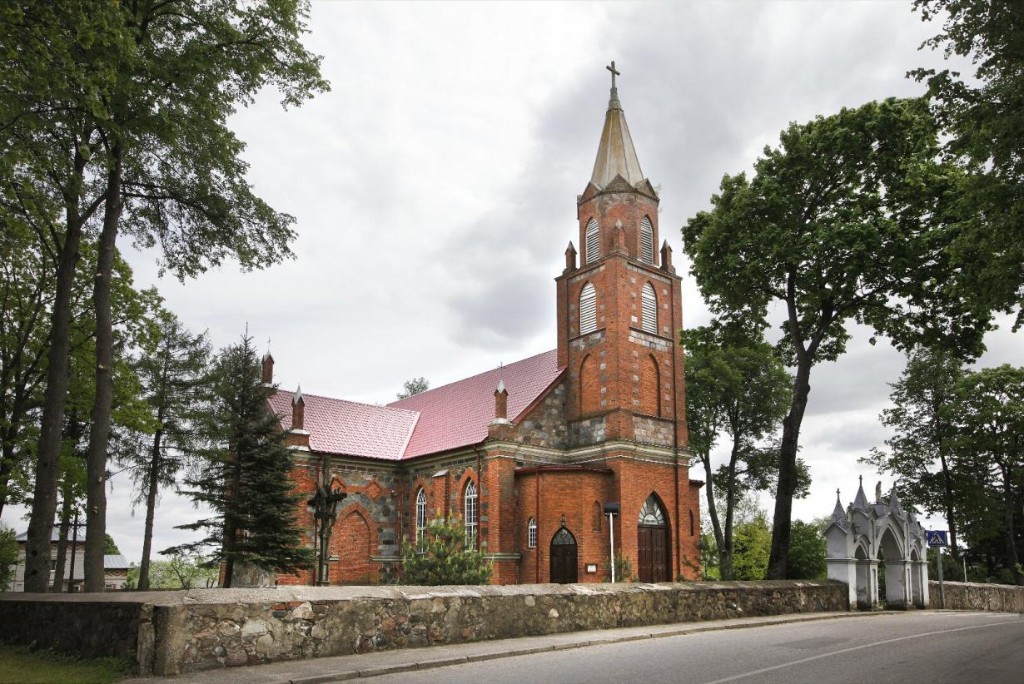
St. Casimir Roman Catholic Church (Igliaukos Šv. Kazimiero bažnyčia), Igliauka, Marijampolė County, Lithuania. Photograph by mikrimas, January 15, 2015, via Wikimedia Commons, licensed under CC BY 3.0.
Introduction
In my previous article, Using DNA to Determine the Origins of My Daukša/Douse Family, I examined several clusters of DNA matches in an effort to identify the Lithuanian origins of my great-grandmother, Eva (Douse) Rice, and determine her mother’s maiden name. That investigation produced two working hypotheses: that the Daukša family may have originated in the vicinity of Igliškėliai (historically served by the Igliauka Roman Catholic parish) in present-day Marijampolė County, and that Eva’s mother, Alistė, may have been a Jankauskaitė. Although neither hypothesis had been established through documentary evidence, the geographical clues provided by the Stramik DNA cluster gave me a specific area of Lithuania in which to begin searching. As a follow-up to that investigation, I undertook a systematic review of the available Roman Catholic parish registers of Igliauka to determine whether my Daukša ancestors could be identified among the families documented there.
Procedure
To investigate the possibility that the Daukša family originated in the vicinity of Igliauka, I undertook a comprehensive surname study using all available Roman Catholic parish registers for Igliauka covering the period from 1823 through 1889. I sought to identify every occurrence of the surname Daukša and its recognizable variants, including Daukšys. By collecting birth, marriage, and death records associated with these families, I hoped to reconstruct family groups, identify the villages in which they resided, and determine whether any of these families could be connected to my known Daukša ancestors.
The records used in this investigation are available through the Lithuanian Electronic Archive Information System (EAIS), which provides a Virtual Reading Room (Virtuali skaitykla) through which researchers can access digitized historical documents held by the Lithuanian state archives. The parish registers examined in this study are held by the Lithuanian State Historical Archives (Lietuvos valstybės istorijos archyvas, or LVIA). Readers wishing to verify my research or conduct their own investigations can access the Virtual Reading Room at https://eais.archyvai.lt/. To locate the Igliauka parish registers, enter the Lithuanian search term Igliaukos. I recommend searching using only the parish name rather than including the abbreviation RKB (Romos katalikų bažnyčia, meaning Roman Catholic Church), as more restrictive search terms may exclude relevant archival collections. The search interface also allows researchers to filter results according to the years covered by the archival documents.
Although I examined all available parish registers within my selected time frame, the surviving collection is incomplete. Several individual registers and entire years are missing from the available digitized records. The following table identifies the gaps encountered during this investigation.
Gaps in surviving Igliauka parish registers (1823–1889)
Year(s)
Registers unavailable
1823
Birth registers
1826
All registers
1830–1832
All registers
1836–1837
All registers
1842–1850
All registers
1854–1856
All registers
1872
Marriage and death registers
1889
Marriage and death registers
Registers from 1890 onward were not examined as part of this study. These gaps are important when interpreting the results of the investigation, particularly when attempting to reconstruct families across multiple generations. The absence of a birth, marriage, or death record does not necessarily indicate that the event occurred outside the parish, as the register in which it would have been recorded may simply be unavailable.
Overcoming Language Barriers
An additional challenge in conducting this research was the language and handwriting of the historical records. The earlier Igliauka parish registers were written in Polish, using nineteenth-century cursive handwriting. Although Polish employs the Latin alphabet, the historical penmanship, spelling conventions, abbreviations, and grammatical inflections can make these documents difficult to interpret, particularly for researchers unfamiliar with the language. Lithuanian given names and surnames were frequently rendered according to Polish linguistic and orthographic conventions, meaning that a family’s surname might appear quite different from its modern Lithuanian form.
During the mid-to-late 1860s, the language of the parish registers transitioned from Polish to Russian. At the time, Igliauka was situated within the Russian Empire, in a region historically associated with the Kingdom of Poland. Following the January Uprising of 1863–1864, the imperial government intensified its policies of Russification, including the increased use of Russian in official administration and civil registration. This transition is reflected in the Roman Catholic parish registers, which served both ecclesiastical and civil registration purposes.
The Russian-language registers present an additional paleographic challenge. Not only were they written using handwritten Cyrillic, but they also employed pre-revolutionary Russian orthography, which preceded the spelling reforms of 1917–1918. This older orthographic system included letters no longer used in modern Russian, such as ѣ (yat), і (decimal i), and ѳ (fita), as well as the frequent use of the hard sign (ъ) at the ends of words. Nineteenth-century cursive letterforms and handwriting conventions also differ in some respects from those encountered in modern Russian handwriting. Consequently, identifying Lithuanian surnames in these registers requires familiarity with historical Cyrillic handwriting, Russian spelling conventions, and the various ways in which Lithuanian and Polish names were rendered in Russian.
Fortunately, I entered this investigation with some familiarity with the Russian language and Cyrillic script. As an undergraduate at the Massachusetts Institute of Technology (MIT), I completed a Russian Language concentration within the Humanities, Arts, and Social Sciences (HASS) program, taking four semesters of Russian (Russian I–IV). As part of our instruction, we were taught to read and write modern Russian cursive, a skill that proved extremely valuable when examining these nineteenth-century parish registers. Although the historical handwriting and pre-revolutionary spelling conventions presented additional challenges, my background in Russian and Polish language enabled me to easily recognize the surname Daukša, typically rendered as Dauksza in Polish and Даукша in Russian, along with its recognizable variants. When interpreting unfamiliar Lithuanian surnames encountered in the registers, I used ChatGPT as a collaborative research tool to brainstorm possible readings, explore spelling variations, and search Lithuanian surname databases for documented native Lithuanian forms. Rather than simply transliterating names from Polish or Russian into Lithuanian, I sought to identify authentic Lithuanian surnames supported by independent sources.
Understanding the Structure of Parish Records
One particularly helpful aspect of researching the Igliauka parish registers was the highly formulaic nature of the entries. Birth, marriage, and death records each followed a relatively standardized narrative structure, both during the period in which the registers were written in Polish and after the transition to Russian. Although individual entries allowed some flexibility to accommodate unusual circumstances or additional information, the fundamental structure remained remarkably consistent.
Once I became familiar with these recurring patterns, I could more readily identify the portions of each entry containing genealogically significant information, such as names, ages, residences, occupations, maiden surnames, and family relationships. This made it possible to review large numbers of records without necessarily having to translate every word of every entry.
To illustrate the nature of these historical documents and the information they contain, I have included representative examples from both the Polish-language and Russian-language periods of the Igliauka parish registers.
Polish-Language Parish Records
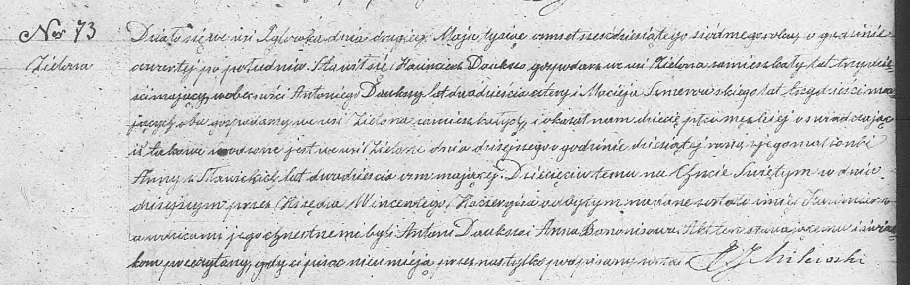
Example 1: Birth and Baptism Record
Birth and baptism entry no. 73 — Kazimierz Daukša, village Zielona (Zielona Buda), registered 20 May 1867 at 8 p.m. (birth and baptism 20 May 1867, 10 a.m.).
Igliauka Roman Catholic Church (Igliaukos Šv. Kazimiero RKB), birth register, 1867, entry no. 73, village Zielona; Lithuanian State Historical Archives (Lietuvos valstybės istorijos archyvas, LVIA), Vilnius, fond 1461 (Ecclesia Romana Catholica S. Casimiri Igluvensis). Digitized register, EAIS Virtual Reading Room (https://eais.archyvai.lt/) — direct volume link to be added.
Transcription (Polish, original orthography)
No. 73
Zielona

Działo się we wsi Iglówka dnia dwadziestego Maja tysiąc osiemset sześćdziesiątego siódmego roku o godzinie ósmej po południu. Stawił się Kazimierz Dauksza, gospodarz we wsi Zielona zamieszkały lat trzydzieści mający w obecności Antoniego Daukszy lat dwadzieścia cztery i Macieja Simerowskiego, lat trzydzieści mającego, obu gospodarzy we wsi Zielona zamieszkałych i okazał nam dziecię płci męskiej oświadczając iż takowe urodzone jest we wsi Zielona dnia dzisiejszego o godzinie dziesiątej z rana z jego małżonki Anny z Sławickich lat dwadzieścia sześć mającej. Dziecięciu temu na Chrzcie Świętym w dniu dzisiejszym przez Księdza Wincentego Kaperlego odbytym nadane zostało imię Kazimierz a rodzicami jego chrzestnymi byli Antoni Dauksza i Anna Banowisowa Akt ten stawającemu i świadkom przeczytany, gdyż pisać nie umieją przez nas tylko podpisany został
C Zhileiszki
English translation
It took place in the village of Igliauka on the twentieth day of May, eighteen hundred sixty-seven, at eight o'clock in the evening.
Appeared Kazimieras Daukša, a farmer residing in the village of Zielona, thirty years of age, in the presence of Antanas Daukša, twenty-four years of age, and Motiejus Simerovskis, thirty years of age, both farmers residing in the village of Zielona, and presented to us a male child, declaring that he was born in the village of Zielona on this same day at ten o'clock in the morning, to his wife, Ona Slavickaitė, twenty-six years of age.
At the Holy Baptism performed on this same day by Father Vincentas Kaperlis, the child was given the name Kazimieras, and his godparents were Antanas Daukša and Ona Banovienė.
This record was read aloud to the declarant and the witnesses, and because they did not know how to write, it was signed only by us.
C. Žileiškis
Russian-Language Parish Records
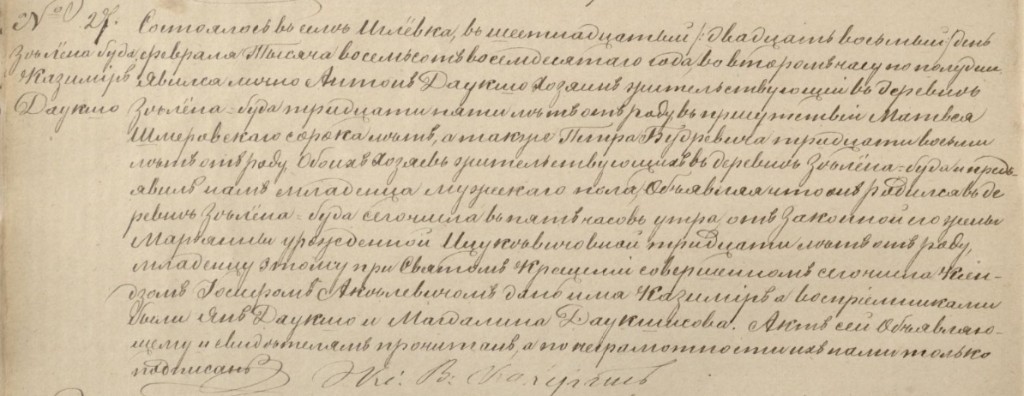
Example 2: Birth and Baptism Record
Birth and baptism entry no. 27 — Kazimieras Daukša, village Zielona Buda (marginalia: Зелёна-буда), registered 16 / 28 February 1880 between 1:00 and 2:00 p.m. (birth 28 February 1880, 5:00 a.m.).
Igliauka Roman Catholic Church (Igliaukos Šv. Kazimiero RKB), birth register, 1880, entry no. 27, village Zielona Buda; Lithuanian State Historical Archives (Lietuvos valstybės istorijos archyvas, LVIA), Vilnius, fond 1461 (Ecclesia Romana Catholica S. Casimiri Igluvensis). Digitized register, EAIS Virtual Reading Room (https://eais.archyvai.lt/) — direct volume link to be added.
Transcription (Russian, original orthography)
№ 27
Зелёна-буда
Казимиръ Даукша

Состоялось въ селѣ Иглёка, въ шестнадцатый/двадцать восьмый день Февраля Тысяча восемьсотъ восемьдесятъ года въ второмъ часу по полудни, явился лично Антонъ Даукша хозяинъ жительствующій въ деревнѣ Зелёна-буда тридцати пяти лѣтъ отъ роду, въ присутствіи Матвея Шмеровскаю сорока лѣтъ, а также Петра Гудревича, тридцати восеми лѣтъ отъ роду, обоихъ Хозяевъ жительствующихъ въ деревнѣ Зелёна-буда и предъявилъ младенца мужескаго пола, объявляя, что онъ родился въ деревнѣ Зелёна-буда сего числа въ пять часовъ утра отъ законной его жены Марянны урождённой Ицукявичовной тридцати лѣтъ отъ роду, младенцу этому при Святомъ Крещеніи совершённомъ сего числа Ксендзомъ Іосифомъ Акчлевичомъ дано имя Казимиръ восприемниками были Янъ Даукша и Магдалина Даукшисова.  Актъ сей объявляющему и свидѣтелямъ прочитанъ а по неграмотности ихъ нами только подписанъ
It took place in the village of Igliauka on February 16 (Julian calendar)/February 28 (Gregorian calendar), 1880, between 1:00 and 2:00 p.m. Antanas Daukša, a householder residing in the village of Zielona Buda, thirty-five years of age, appeared in person in the presence of Motiejus Šmerovskis, forty years of age, and Petras Gudrevičius, thirty-eight years of age, both householders residing in the village of Zielona Buda.
He presented a male infant, declaring that the child had been born in the village of Zielona Buda on this date at 5:00 AM, to his lawful wife, Marijona, née Icukevičiūtė, thirty years of age.
At the Holy Baptism performed for this infant on the same date by Father Juozas Akčlevičius, the child was given the name Kazimieras. His godparents were Jonas and Magdalena Daukša.
This record was read aloud to the declarant and the witnesses, and because they were illiterate, it was signed only by us:
Rev. V. Kaperlis
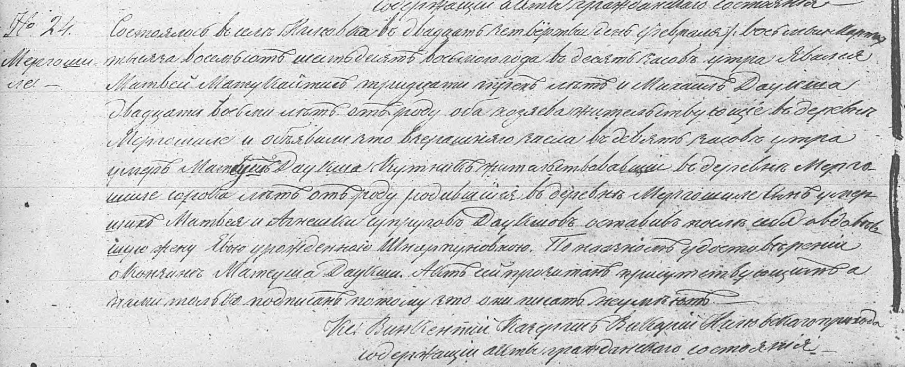
Example 3: Death Record
Death entry no. 27 — Matas Daukša, village Mergašilis (marginalia: Мергашиле), registered 24 February / 8 March 1868 at 10 a.m. (death 7 March 1868, 9 a.m.).
Igliauka Roman Catholic Church (Igliaukos Šv. Kazimiero RKB), death register, 1868, entry no. 27, village Mergašilis; Lithuanian State Historical Archives (Lietuvos valstybės istorijos archyvas, LVIA), Vilnius, fond 1461 (Ecclesia Romana Catholica S. Casimiri Igluvensis). Digitized register, EAIS Virtual Reading Room (https://eais.archyvai.lt/) — direct volume link to be added.
Transcription (Russian, original orthography)
№ 27
Мергашиле

Состоялось въ селѣ Игляка, въ двадцать четвёртви день февраля/восьмви марта Тысяча восемьсотъ шестьдесят восьмого года въ десять часовъ утра явился Матвей Манеукайтисъ тридцати трехъ лѣтъ и Михаилъ Даукша двадцати восьми лѣтъ отъ роду оба хозяева жительствующій въ деревнѣ Мергашиле и объявили что вчерашняго числа въ девять часовъ утра умеръ Матвеушъ Даукша кутникъ житальствовавшій въ деревнѣ Мергашиле сорока лѣтъ отъ роду родившийся въ деревнѣ Мергашиле сынѣ умершикъ Матвея и Агнешки супруговъ Даукшовъ оставивъ послѣ себя овдовѣвшую жену Евою урождённою Шнарпуновкою.  По надлежащемъ удостовереніи скончанія Матеуша Даукша.  Актъ сей прочитанъ присутствующимъ а нами только подписанъ потому что они писать не умѣютъ.
Кс. Винкентій Каперлій Викарій Иглювскаго прихода
ведущій акты гражданскаго состоянія
Latin-alphabet transliteration
No. 27
Mergašile

Sostoyalos' v" sele Iglyaka, v" dvadtsat' chetvyortyi den' fevralya/vos'mogo marta Tysyacha vosem'sot' shest'desyat vos'mogo goda v" desyat' chasov" utra yavilis' Matvey Maneukaytis" tridtsati trekh" let" i Mikhail" Dauksha dvadtsati vos'mi let" ot" rodu oba khozyaeva zhitel'stvuyushchiy v" derevne Mergashile i ob'yavili, chto vcherašnego chisla v" devyat' chasov" utra umer" Matveush" Dauksha kutnik" zhitel'stvovavshiy v" derevne Mergashile soroka let" ot" rodu rodivshiysya v" derevne Mergashile syn" umershikh" Matveya i Agneshki suprugov" Daukshovykh, ostaviv posle sebya ovdovevshuyu zhenu Evoyu urozhdyonnuyu Shnarpunovskuyu. Po nadlezhaschemu udostoverenii skonchaniya Mateusha Dauksha. Akt" sey prochitan prisutstvuyushchim, a nami tol'ko podpisan, potomu chto oni pisat' ne umeyut.
Ks. Vinkentiy Kaperliy, vikariy Iglyvskago prikhoda
vedushchiy akty grazhdanskago sostoyaniya
English translation
No. 27
Mergašilis
On the February 24 (Julian calendar)/March 8 (Gregorian), 1868, at 10:00 AM, in the village of Igliauka, appeared Matas Maneukaitis, thirty-three years of age, and Mykolas Daukša, twenty-eight years of age, both householders residing in the village of Mergašilis.
They declared that yesterday, at 9:00 AM, Matas Daukša, a lodger residing in the village of Mergašilis, died at the age of forty years.
The deceased was born in the village of Mergašilis and was the son of the late Matas and Agnė Daukša, both deceased. He left behind his widow Ieva, née Šnarpūnaitė.
After due verification of the death of Matas Daukša, this record was read aloud to those present and signed only by us, because they did not know how to write.
Father Vincentas Kaperlis
Vicar of the Igliauka Parish
Keeper of the Civil Status Records
Recommended Translation Resources
During a conversation with my friend and fellow genealogist Gila Jones, she recommended a series of genealogical translation guides entitled In Their Words: A Genealogist’s Translation Guide, by Jonathan Shea and William F. Hoffman. Although I have not personally read these books, I wanted to share her recommendation with readers who may be undertaking similar research.
The Russian-language volume, revised in 2014, appears particularly relevant to this investigation. According to its published description, it contains 88 historical documents and extracts with accompanying analyses and translations, including examples of birth, marriage, and death records. It also covers Russian grammar, phonetics, and spelling, and includes an extensive vocabulary of archaic terminology and a multilingual guide to given names. These resources appear especially useful when working with historical parish registers containing terminology and spelling conventions that are not readily found in modern dictionaries.
Readers interested in developing their own skills in interpreting historical genealogical records may wish to explore the volumes in this series relevant to the languages encountered in their research.
The systematic review of the Igliauka parish registers resulted in the reconstruction of eight Daukša family trees, representing families principally associated with three villages: Igliauka, Mergašilis, and Zielona Buda. The extent to which these families could be connected through the available documentary evidence varied considerably among the three villages.
In Zielona Buda, I was able to reconstruct a single extended family tree that accounted for all individuals bearing the Daukša surname identified in the available records for that village. In Igliauka itself, the records yielded two relatively small family trees. I suspect that both represent branches of the larger Daukša family associated with Mergašilis, although the available records did not permit me to establish those connections.
Mergašilis contained by far the most genealogically complex concentration of Daukša families, requiring five separate family trees to document the relationships that could be established through the available records. Despite presenting these as separate trees, I suspect that they represent branches of a single extended family whose common ancestors lived before the earliest available parish registers. Had records survived from before 1823, it might have been possible to connect these branches into a single family tree.
The geographical distribution and relative complexity of these family groups suggest a possible pattern of settlement. The presence of multiple established Daukša family branches in Mergašilis may reflect a longer history of the family in that village than in the surrounding communities. If the Daukša families identified within the parish ultimately share a common ancestor, Mergašilis may represent their ancestral center, with the families of Zielona Buda and Igliauka representing branches that subsequently became established in neighboring villages. Although the available parish registers do not extend far enough into the past to establish these connections, this hypothesis offers a plausible explanation for the geographical distribution and genealogical complexity of the reconstructed families.
The eight reconstructed family trees are presented below, grouped according to their principal village of residence. Their presentation as separate trees reflects the limitations of the available documentary evidence rather than an assertion that they represent unrelated families.
Mergašilis
Simonas (1770) of Mergašilis
1. Simonas Daukša b: est 1770. d: Deceased.
+ Elžbieta Kudžmaitė b: est 1775. d: Deceased.
2. Elžbieta Daukša b: abt 1800. d: Deceased.
+ Petras Skripinskis m: 1827 in Mergašilis, Marijampolės, Marijampolės, Lithuania. d: Deceased.
The principal objective of this investigation was to identify a Daukša family that included three brothers, Petras, Mykolas, and Jonas, who subsequently immigrated to the United States. Of particular importance was the identification of Jonas and his wife, Aistė, and their two daughters, Marijona and Ieva, who remained in Lithuania until joining Jonas in the United States in 1890. Based on information obtained from American census and immigration records, I established approximate dates for the births and marriages that I hoped to locate in the Igliauka parish registers.
The following table summarizes the information available from American records prior to this investigation.
American records — Daukša family summary (pre-investigation)
Individual
Source
Recorded information
Petras Daukša
1900 U.S. Census
Age 40; married in approximately 1880; immigrated in 1891; wife Ona
1910 U.S. Census
Age 40
1920 U.S. Census
Age 56
Mykolas Daukša
1900 U.S. Census
Born September 1861; immigrated in 1881; married in approximately 1888
1910 U.S. Census
Reported age consistent with the 1900 census
Jonas Daukša
1900 U.S. Census
Born July 1859; immigrated in 1889; widowed
1910 U.S. Census
Age 48
1920 U.S. Census
Age 53
Aistė Daukšienė
1890 Passenger List
Age 30
Marijona Daukšaitė
1890 Passenger List
Age 5
1900 U.S. Census
Born June 1880
Ieva Daukšaitė
1890 Passenger List
Age 3
1900 U.S. Census
Born June 1883
Several discrepancies are apparent in the ages and birth dates reported in these records. The ages recorded for Petras and Jonas varied considerably between census years, while the ages of Marijona and Ieva reported on the 1890 passenger list suggest substantially later birth dates than those recorded in the 1900 census. In Ieva's case, accepting the age reported on the passenger list would place her at approximately thirteen years of age at the time of her marriage, making the earlier birth date more plausible. Consequently, I allowed for a considerable margin of error when evaluating potential matches in the Lithuanian parish registers.
In addition to the birth records of the six individuals identified above, I hoped to locate the marriage records of Petras and Ona and of Jonas and Aistė. Petras and Ona had no known children, limiting the opportunities to identify their family through birth and baptism records. Mykolas married after immigrating to the United States, so his marriage record was not expected to appear in the Lithuanian registers.
Despite the extensive reconstruction of the Daukša families documented in the Igliauka parish registers, I was unable to identify records corresponding to my known ancestors and their relatives. Even allowing for considerable discrepancies in the ages and birth dates reported in American records, none of the reconstructed families exhibited the combination of individuals and family relationships that I was seeking. In particular, I found neither a family containing the three brothers within the expected birth-year ranges nor a family headed by Jonas Daukša with daughters named Marijona and Ieva corresponding to the known family.
Conclusion
Although there are significant gaps in the available Igliauka parish registers, these gaps are insufficient to explain the absence of my Daukša family from the records. Given the number of individuals involved, the approximate dates of their births and marriages, and the extent of the surviving documentation, I would reasonably have expected to find evidence of at least some members of this family had they resided within the parish. The absence of any identifiable records corresponding to the family, even after allowing for substantial discrepancies in the ages and birth dates reported in American records, constitutes significant negative evidence.
Furthermore, Eva's religious affiliation is well established through records of her life in the United States. She was a practicing Roman Catholic, making it unlikely that the absence of her family from the Roman Catholic parish registers can be attributed to membership in another religious denomination.
Based on the cumulative evidence, I conclude that Eva Douse was almost certainly not born within the Igliauka parish. Although the incomplete nature of the surviving registers prevents an absolute determination, the wealth of available records and the absence of evidence of her immediate family provide sufficient grounds to reject Igliauka as the probable parish of origin.
Revisiting the Stramik Cluster
Following the publication of my previous article and following the above analysis, I conducted additional genealogical research into the Stramik family, examining Roman Catholic church records from Illinois. Based on my personal examination of the various spellings of the surname as recorded in these documents, I concluded that the original Lithuanian surname was most likely Štreimikis.
This finding has important implications for the geographical hypothesis that prompted my investigation of the Igliauka parish. In my previous article, I had identified an ancestral line bearing the surname Strampikas in the family tree of a DNA match associated with the Stramik cluster. That family had documented origins in Igliškėliai, and I had hypothesized that Strampikas might represent a variant of the surname subsequently Americanized as Stramik.
The identification of Štreimikis as the probable original surname of the Illinois Stramik family substantially weakens that hypothesis. Štreimikis and Strampikas are sufficiently distinct in their linguistic structure that there is little justification for treating them as variants of the same Lithuanian surname without additional documentary evidence.
Furthermore, the DNA match whose family tree contained the Strampikas ancestral line was not a close relative of the individuals forming the core of the Stramik cluster. This individual descends from Lithuanian immigrant coal-mining families in Pennsylvania through numerous ancestral lines, any of which could potentially account for the genetic connection to my Douse family and to the Stramik family from which the core cluster members of the cluster belong. There is therefore no compelling reason to attribute that connection specifically to the Strampikas line.
Taken together, the negative findings from the Igliauka parish registers and the identification of Štreimikis as the probable original surname of the Stramik family substantially undermine the geographical hypothesis developed in my previous article. The genetic connections identified within the Stramik cluster remain relevant, but the geographical significance previously attributed to the Strampikas ancestral line must now be reconsidered.
A New Hypothesis for the Daukša Family’s Origins
Having identified Štreimikis as the probable original Lithuanian surname of the Stramik family, I used ChatGPT to assist in investigating the historical geographical distribution of this surname in Lithuania. Because Štreimikis is considerably less common than Daukša, tracing its historical distribution offered a potentially more effective means of narrowing the geographical scope of my research. Through an examination of indexed Lithuanian parish records and other historical sources, we identified a concentration of families bearing the Štreimikis surname in the Kalvarija area of present-day Marijampolė County. This finding suggests that Kalvarija and its surrounding communities may represent the ancestral homeland of the Stramik family and provides a new geographical focus for my investigation of the Daukša family.
Interestingly, this new hypothesis may also explain another pattern observed in my DNA research. Eva Douse's future husband, my great-grandfather Peter Rice was the son of Juozapas Račius and Marija Vilkauskaitė. Although the Račius family originated in the Bartninkai parish, also located in present-day Marijampolė County, Marija Vilkauskaitė was from Kalvarija. I have observed that many DNA matches belonging to clusters previously identified as originating on the Douse side of my family also appear in one or more of my Vilkauskas clusters. If the Daukša family also originated in the Kalvarija area, this overlap might be explained by the interconnected nature of families within the local population. Descendants of families with deep ancestral roots in the same community could share common ancestors with both Marija Vilkauskaitė and Eva Douse through entirely different branches of their family trees. Thus, the overlap between these otherwise distinct DNA clusters may reflect a shared geographical origin rather than a single common ancestral line.
The next step in this investigation will be to determine what genealogical records are available for the Kalvarija parish and undertake a systematic examination of those records, similar to the study conducted for Igliauka. In a future article, I will explore the surviving parish registers and other relevant historical sources in an effort to establish whether documentary evidence supports or contradicts this new hypothesis concerning the ancestral origins of my Daukša family.